
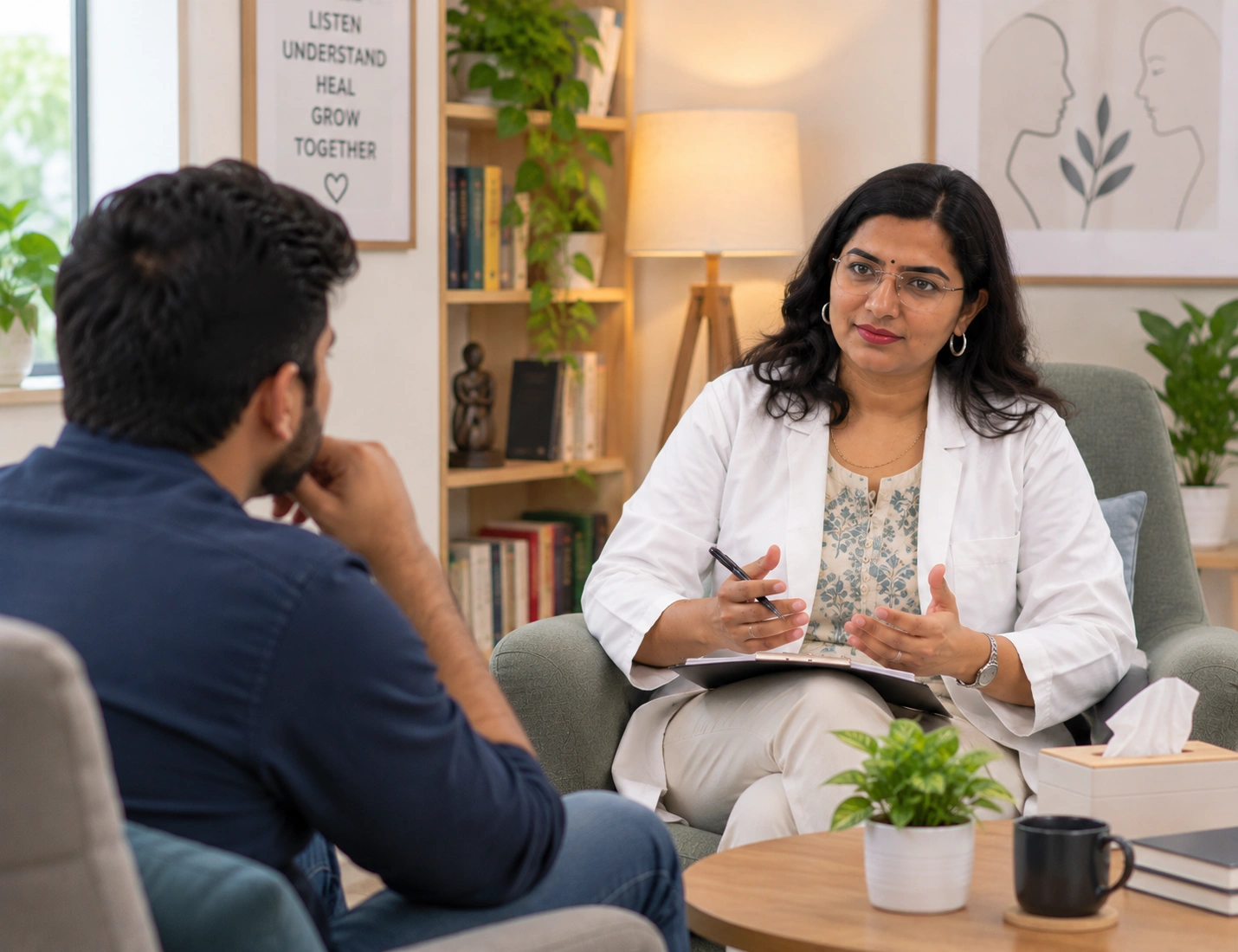
Marriage can bring companionship, emotional connection, shared responsibilities, and meaningful experiences. At the same time, every relationship can go through periods of disagreement, misunderstanding, emotional distance, or uncertainty.
Sometimes couples are able to work through these difficulties themselves.
At other times, the same arguments keep returning, communication becomes increasingly difficult, trust has been affected, or both partners simply feel that they are no longer understanding each other.
Online marriage counselling in India provides couples with an opportunity to discuss relationship concerns with a mental health professional without necessarily having to visit a clinic together.
For couples living in different cities, managing demanding work schedules, or simply preferring the convenience and privacy of remote sessions, online counselling can provide a more accessible way to seek professional relationship support.
At Ramya Clinic, couple and marriage counselling focuses on helping partners better understand communication patterns, relationship difficulties, emotional needs, and possible ways forward in a professional and non-judgmental environment.
What Is Online Marriage Counselling?
Online marriage counselling is professional relationship counselling conducted remotely through an appropriate online consultation format.
Both partners can participate in sessions with a psychologist or counsellor to discuss concerns affecting their relationship.
Depending on the couple’s circumstances, counselling may explore areas such as:
- Communication problems
- Frequent arguments
- Emotional distance
- Trust difficulties
- Intimacy concerns
- Family interference
- Differences in expectations
- Parenting disagreements
- Financial stress
- Work-life pressure
- Major life changes
- Premarital concerns
- Separation-related decisions
Marriage counselling is not simply about deciding who is right and who is wrong.
Instead, therapy can help couples understand how they communicate, respond to conflict, express emotions, interpret each other’s behaviour, and approach recurring relationship problems.
How Does Online Marriage Counselling Work?
Although the exact process depends on the couple and therapist, online marriage counselling commonly involves several stages.
1. Initial Consultation
The first session gives the therapist an opportunity to understand the relationship and the reasons the couple is seeking support.
The psychologist may ask about:
- Current relationship concerns
- How long the difficulties have been present
- Important relationship history
- Communication patterns
- Frequent sources of conflict
- Emotional connection
- Family circumstances
- Major recent changes
- Expectations from counselling
Both partners may have different perspectives on the same situation.
A therapist’s role is not necessarily to determine which version is “correct,” but to understand the relationship dynamics and concerns affecting both partners.
2. Understanding the Relationship Pattern
Many couples believe they are repeatedly arguing about different issues.
Money this week.
Household responsibilities next week.
Family members the week after.
But underneath different disagreements, there may sometimes be a recurring interaction pattern.
For example:
Partner A feels ignored → raises the issue angrily → Partner B feels criticized → withdraws → Partner A feels even more ignored → conflict increases.
Marriage counselling can help couples recognize patterns like these.
Understanding the pattern can be important because the relationship problem may not always be only about the topic being discussed—it can also involve how both partners respond to each other during difficult moments.
3. Identifying Counselling Goals
Couples may enter counselling with very different goals.
Some want to:
- Communicate more effectively
- Reduce frequent arguments
- Rebuild emotional connection
- Address trust concerns
- Understand each other’s needs
- Manage family conflicts
- Improve intimacy
- Navigate parenting disagreements
- Prepare for marriage
- Discuss separation constructively
The therapist can help clarify realistic therapeutic goals based on the couple’s circumstances.
4. Improving Communication
Communication is one of the most common areas addressed in relationship counselling.
Healthy communication involves more than simply talking.
It can include learning how to:
- Express concerns clearly
- Listen without immediately becoming defensive
- Communicate emotions appropriately
- Understand another perspective
- Discuss difficult topics respectfully
- Avoid personal attacks
- Recognize emotional triggers
- Set appropriate boundaries
The objective is not to eliminate every disagreement.
Even healthy couples disagree.
The goal may instead be to develop healthier ways of navigating disagreements.
5. Understanding Emotional Needs
Two people can care about each other while expressing emotional needs differently.
One partner may want conversation when distressed.
The other may need time alone before talking.
One may value verbal reassurance.
The other may primarily express care through practical actions.
These differences can sometimes create misunderstandings.
Counselling may help partners communicate their needs more clearly while understanding how the other person experiences the relationship.
6. Practicing Relationship Skills
Therapy should not remain limited to what happens during the counselling appointment.
Depending on the couple’s needs, the therapist may encourage appropriate communication exercises, reflection, problem-solving, or other strategies between sessions.
The purpose is to help couples apply therapeutic learning to everyday interactions.
When Should Couples Consider Marriage Counselling?
You do not necessarily have to wait until a marriage reaches a breaking point before considering professional support.
Couples may seek counselling when they notice:
- Frequent arguments
- Communication breakdown
- Emotional distance
- Difficulty resolving conflicts
- Trust concerns
- Repeated misunderstandings
- Intimacy difficulties
- Family-related conflicts
- Parenting disagreements
- Work-related relationship stress
- Difficulty adjusting after marriage
- Major differences in expectations
- Thoughts about separation
Early support may sometimes help couples address patterns before they become more deeply established.
Online Marriage Counselling for Communication Problems
Communication difficulties can appear in many forms.
Some couples argue frequently.
Others stop communicating almost completely.
One partner may feel:
“You never listen to me.”
The other may respond:
“Whatever I say becomes an argument.”
Eventually both partners can feel misunderstood.
Marriage counselling may help couples recognize communication habits such as:
- Interrupting
- Blaming
- Criticizing
- Avoiding difficult conversations
- Becoming defensive
- Withdrawing
- Assuming intentions
- Bringing previous conflicts into every disagreement
Recognizing these patterns can create opportunities to communicate differently.
Marriage Counselling for Frequent Arguments
Arguments do not automatically mean a relationship is unhealthy.
What matters is often how conflict is handled.
Repeated conflict can become particularly difficult when disagreements involve:
- Insults
- Personal attacks
- Constant criticism
- Threats
- Refusal to communicate
- Repeatedly revisiting unresolved issues
Counselling can provide a structured environment for understanding what drives recurring disagreements and developing healthier conflict-management strategies.
Online Marriage Counselling for Trust Issues
Trust can be affected by many experiences.
These may include:
- Dishonesty
- Broken promises
- Secrecy
- Emotional disconnection
- Previous relationship experiences
- Financial disagreements
- Infidelity
- Repeated boundary violations
Rebuilding trust is rarely as simple as telling someone to “move on.”
Depending on the circumstances, counselling may help couples explore what happened, understand its emotional impact, discuss boundaries, and determine what rebuilding trust would require.
Not every relationship will reach the same outcome.
The purpose of counselling is to support thoughtful and psychologically informed conversations rather than guarantee reconciliation.
Marriage Counselling After Infidelity
Infidelity can create intense emotions including anger, grief, fear, confusion, guilt, and uncertainty.
Some couples want to explore rebuilding their relationship.
Others are unsure whether they want to continue.
Marriage counselling can provide a structured environment for discussing what has happened and exploring the relationship’s future.
The therapist should not force either partner to stay in or leave the marriage.
The couple ultimately makes its own relationship decisions.
Family Interference and Marriage Problems
In India, marriage can sometimes involve relationships not only between two individuals but also between families.
Couples may experience difficulties involving:
- In-laws
- Family expectations
- Living arrangements
- Cultural expectations
- Financial responsibilities
- Household roles
- Boundaries with relatives
- Parenting expectations
The goal of counselling is not to automatically blame family members.
Instead, therapy may help the couple understand expectations, communicate needs, establish appropriate boundaries, and decide together how they want to approach family relationships.
Marriage Counselling for Financial Stress
Money can become a major source of relationship tension.
Partners may disagree about:
- Spending
- Saving
- Debt
- Financial priorities
- Supporting extended family
- Household expenses
- Career decisions
- Financial independence
Sometimes the argument appears to be about money but also involves deeper concerns about security, responsibility, fairness, or control.
Counselling can help couples discuss these concerns more constructively.
Online Counselling for Work-Life and Relationship Stress
Long working hours, commuting, career pressure, business responsibilities, or different work schedules can reduce the amount of meaningful time couples spend together.
Over time, one or both partners may begin to feel disconnected.
Counselling may help couples explore:
- Expectations
- Time together
- Communication
- Responsibilities
- Boundaries around work
- Emotional connection
- Shared priorities
The objective is to find realistic approaches that fit the couple’s actual circumstances.
Premarital Counselling Online in India
Couple counselling does not have to begin after problems develop.
Premarital counselling can help couples discuss important expectations before marriage.
Topics may include:
- Communication
- Finances
- Career expectations
- Family involvement
- Household responsibilities
- Children and parenting
- Personal boundaries
- Values
- Conflict resolution
- Lifestyle expectations
The purpose is not to predict whether a marriage will succeed.
It is to encourage conversations about important areas that couples may otherwise avoid until after marriage.
Can Long-Distance Couples Attend Online Counselling?
Online counselling can be particularly useful when partners are living in different locations.
For example, one partner may be working in Delhi while another is living in Lucknow, Mumbai, Bengaluru, Hyderabad, Pune, Kolkata, or another city.
Where technically and clinically appropriate, both partners may be able to join the same online session from separate locations.
The therapist can explain how sessions should be arranged and what privacy requirements apply.
Benefits of Online Marriage Counselling
Online relationship counselling can provide several practical advantages.
Attend From Different Locations
Both partners may not need to be physically present in the same city.
This can be especially helpful for long-distance couples or marriages affected by work-related relocation.
Reduced Travel
Couples can avoid travelling to a clinic for every appointment.
Greater Scheduling Flexibility
Online sessions may be easier to coordinate around work, family, or other responsibilities.
Familiar Environment
Some couples may feel more comfortable discussing personal relationship concerns from their own private space.
Access Beyond Your City
Online counselling can make it possible to explore professional support without limiting the search only to nearby clinics.
How to Prepare for an Online Marriage Counselling Session
A few practical steps can make an online session more productive.
Choose a Private Space
Both partners should be able to speak without being overheard or frequently interrupted.
Avoid Joining During an Active Argument
Where possible, allow some time to settle before beginning the session so the appointment can focus on constructive therapeutic work.
Reduce Digital Distractions
Silence unnecessary notifications and avoid checking other apps during the session.
Be Prepared to Listen
Marriage counselling is not only an opportunity to explain your side.
Listening to your partner’s experience can also be an important part of the process.
Be Open About Your Goals
Tell the therapist what you hope to understand or change.
What Marriage Counselling Is Not
There are several misconceptions about couple counselling.
“The Therapist Will Decide Who Is Right.”
Generally, therapy is not a courtroom.
The focus is on understanding relationship patterns and helping both people communicate more effectively.
“The Therapist Will Tell Us Whether to Divorce.”
Relationship decisions belong to the couple.
A therapist can help clients explore concerns and options but should not simply make major personal decisions for them.
“Only Unhappy Couples Need Counselling.”
Couples may also seek support to strengthen communication, prepare for marriage, navigate transitions, or address concerns before they become more serious.
“One Session Will Fix Everything.”
Relationship patterns often develop over time.
Meaningful change may require practice, consistency, and multiple conversations.
Can One Partner Attend Marriage Counselling Alone?
Sometimes only one partner is initially willing to seek professional help.
Individual counselling may still help that person explore:
- Emotional responses
- Communication
- Personal boundaries
- Relationship expectations
- Decision-making
- Coping strategies
However, individual counselling is not the same as couple therapy because the therapist is working with only one person’s experience.
If joint marriage counselling is appropriate, the therapist can discuss how both partners may become involved.
Marriage Counselling vs Individual Therapy
Marriage counselling focuses primarily on the relationship and interactions between partners.
Individual therapy focuses on one person’s emotional, psychological, or behavioural concerns.
Sometimes both may be relevant.
For example, a couple may attend relationship counselling while one partner separately receives individual psychological support for an unrelated concern.
The appropriate arrangement should be discussed with the mental health professional.
Is Online Marriage Counselling Confidential?
Privacy is particularly important when discussing relationships.
Professional counselling should include clear information about confidentiality, record-keeping, online-session privacy, and any applicable limits of confidentiality.
Couples should also take practical steps to protect their privacy.
Attend sessions from a private location, use personal devices where possible, and avoid recording sessions unless this has been appropriately discussed and agreed.
What If There Is Abuse or a Safety Concern?
Not every relationship difficulty should be treated as an ordinary communication problem.
Where there is domestic violence, coercive control, threats, stalking, serious intimidation, or immediate risk of harm, standard couple counselling may not always be the appropriate first intervention.
Safety should be prioritized.
A qualified professional can help assess the circumstances and identify appropriate individual, emergency, legal, medical, or specialist support.
If there is immediate danger, contact appropriate local emergency services.
How Many Marriage Counselling Sessions Are Needed?
There is no fixed number of sessions that works for every couple.
The duration can depend on:
- Nature of the relationship concerns
- How long difficulties have been present
- Therapeutic goals
- Both partners’ participation
- Complexity of the situation
- Progress during counselling
Be cautious about services promising to “save your marriage” within a guaranteed number of sessions.
No ethical therapist can guarantee a particular relationship outcome.
How to Choose an Online Marriage Counsellor in India
Before beginning counselling, consider the professional rather than choosing only on the basis of price or social-media popularity.
You may want to consider:
- Professional qualifications
- Training and experience
- Experience working with couples
- Approach to relationship counselling
- Confidentiality practices
- Online consultation process
- Communication style
- Session structure
- Fees and scheduling
- Whether you feel comfortable discussing personal concerns
It is reasonable to ask questions before committing to ongoing counselling.
Online Marriage Counselling at Ramya Clinic
Ramya Clinic provides professional support for couples experiencing relationship and marital concerns.
Couple and relationship counselling may address areas including:
- Communication difficulties
- Trust concerns
- Intimacy issues
- Marriage-related difficulties
- Relationship conflicts
- Premarital concerns
- Separation and divorce-related support
- Family conflicts
- Emotional disconnection
Ramya Clinic provides both online and in-person psychological services, allowing clients to explore a consultation format suited to their circumstances.
Online Marriage Counselling in India With Ramya Clinic
Couples do not necessarily need to live in Moradabad to explore an online consultation with Ramya Clinic.
Online services can provide greater accessibility for couples living in different cities or managing demanding schedules.
The process begins by understanding the relationship concerns and determining what type of psychological support is appropriate.
Marriage counselling is personalized because every relationship has its own history, circumstances, challenges, strengths, and goals.
Frequently Asked Questions About Online Marriage Counselling in India
What is online marriage counselling?
Online marriage counselling is professional relationship counselling conducted remotely. Couples can discuss communication, trust, conflict, emotional connection, and other relationship concerns with a mental health professional.
Does online marriage counselling work?
Online counselling can provide a structured professional environment for suitable couples to work on relationship concerns. Outcomes vary according to the couple, concerns, participation, therapeutic process, and other circumstances.
Can both partners join from different cities?
Depending on the online platform and counselling arrangement, partners may be able to participate from different locations. Confirm the setup with the therapist before your appointment.
Is marriage counselling only for couples considering divorce?
No. Couples may seek counselling for communication problems, frequent conflicts, trust difficulties, premarital guidance, family issues, emotional distance, or simply to improve their relationship.
Can marriage counselling help with communication problems?
Communication is a common focus of couple counselling. Therapy may help partners understand communication patterns, express concerns more clearly, listen more effectively, and manage disagreements differently.
Can counselling help after infidelity?
Some couples seek professional support after infidelity to process emotions, understand what happened, discuss trust, and explore the future of their relationship. Counselling cannot guarantee reconciliation.
Is premarital counselling available online?
Premarital counselling can be conducted online where appropriate and may address expectations around communication, finances, family, careers, children, responsibilities, boundaries, and conflict.
Can I take marriage counselling without my partner?
Individual counselling can help you explore your own relationship concerns and responses, although it is different from couple counselling involving both partners.
How many marriage counselling sessions do we need?
There is no universal number. The duration depends on the couple’s concerns, goals, circumstances, engagement, and progress.
Is online marriage counselling confidential?
Professional counselling should follow appropriate confidentiality and privacy practices, with limitations explained by the therapist. Clients should also participate from a private environment.
A Healthier Conversation Can Be a Starting Point
A difficult period in a marriage does not always mean the relationship has reached its end.
At the same time, counselling is not about forcing two people to remain together regardless of their circumstances.
It provides a professional space to understand what is happening between you, how each partner experiences the relationship, which patterns keep repeating, and what changes may be possible.
Sometimes the first meaningful change is not solving every relationship problem.
It is learning how to have a different conversation about it.
If you are searching for Online Marriage Counselling in India, you can connect with Ramya Clinic to discuss your relationship concerns and understand what form of professional psychological support may be appropriate.
Ramya Clinic – Compassion. Care. Clarity.